
Finders Keepers
The Chew Valley Hoard has inspired an interest in history and culture in the area it was discovered. James Garrett takes a closer look at some of the questions it has raised.

Dear readers
Today’s article is a summer holiday departure from our usual fare and is for all of our readers. James Garrett takes a look at the Chew Valley Hoard and the interest in the history of (to say nothing of location of) the find.
Our work is paid for by our paying subscribers. For £30 a year they get a minimum of 48 extra exclusive articles a year.
If you’d like to join them, you can sign up here:
Thank you
Andrew Lee - Editor
Next weekend, a community play is to be staged in the Chew Valley, inspired by the remarkable - and true - story how more than 2,500 silver pennies, today worth £4.3million, were rediscovered seven years ago, after being lost for almost a millennium.
The production of Finders Keepers is just one of a string of activities taking place in north Somerset to celebrate the Chew Valley Hoard, ahead of its permanent exhibition in 2028 in the Museum of Somerset, Taunton.
Between September and January 2027, when the hoard goes on show in Bath, it can be seen at the British Museum, alongside the Bayeux Tapestry, which arrived in London at the weekend, on loan from France.
Curator Michael Lewis, said, “The display of the Bayeux Tapestry at the British Museum offers visitors a once-in-a-lifetime opportunity to be part of history. This will be an exciting presentation of the events leading to the Norman Conquest, an incredible moment that changed England forever.”
The coins will form part of an exhibition describing the aftermath of the Norman Conquest. The Museum’s senior conservator, Pippa Pearce, who had the task of cleaning them, said, “They were very well preserved, due to a lucky combination of good quality silver going into ground that contains nothing too corrosive.”
In Somerset, where the tapestry’s companion exhibits were discovered in 2019 by a group of metal detectorists, the play is being staged by Valley Arts, a local cultural organisation.
It has partnered with South-West Heritage Trust which owns the coins, thanks to a grant from the Heritage Lottery Fund. SWHT will also, eventually, be responsible for housing them in Taunton - as we reported some 18 months ago. (https://somersetconfidential.substack.com/p/uncertain-times?utm_source=publication-search)
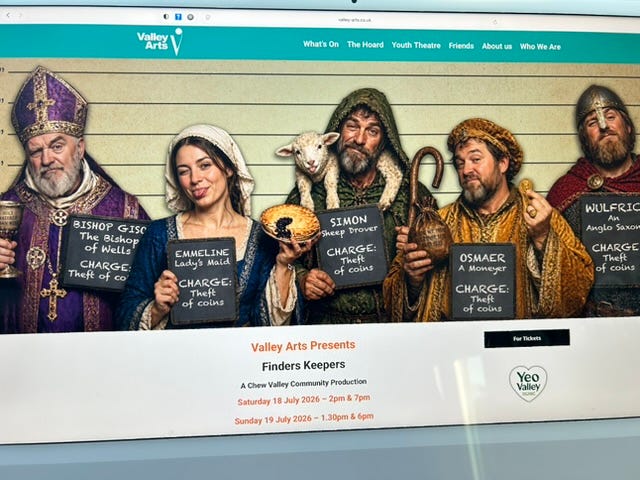
A cast of 40 local residents has been recruited, in a Traitors-like ‘whodunnit,’ to solve the mystery of a stolen hoard. Not stinting on dramatic licence, the show’s host, Claudia Twinkleclaw (sic), will present five ‘suspicious’ characters, each of whom might have had something to gain by stealing the coins.
The publicity material declares, “You get to decide who did it! Take your place at the round table, hear the evidence and vote!”
The ‘suspects’ are the lord of the manor, the Bishop of Bath & Wells, allegedly “more interested in mead than sermons;“ Simon, a sheep drover trying to provide for his sweetheart; Emmeline, a lady’s maid seeking a more comfortable life; Wulfric, an Anglo-Saxon looking to get rich quick, and Osmaer, a moneyer, someone who, at the time of the Conquest, minted coins.
Spoiler alert: there is no reason to believe that, historically, the coins were stolen! On the other hand, neither is there an accepted explanation for their disappearance - nor any likelihood of finding one.
The hoard was buried in 1068, at a time of serious political unrest, by someone who, for whatever reason, failed to return for them.
The 2,584 coins date from the reigns of Edward The Confessor, who died in 1066, Harold, who briefly replaced him that year, and William 1.
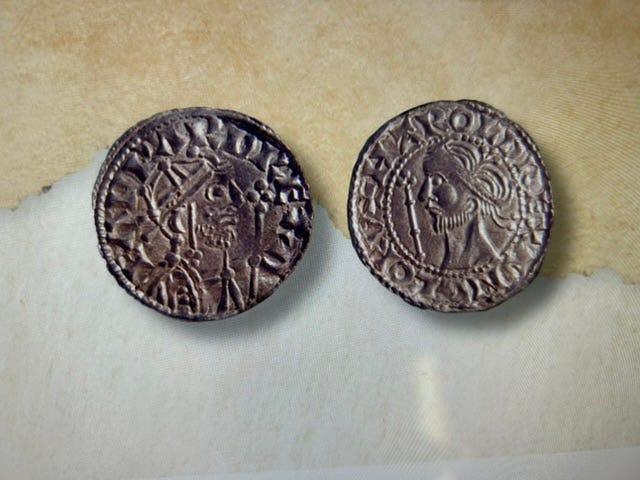
Adam Staples, who led the team of detectorists which discovered the hoard during the torrential rain which fell on 26 January 2019, told us just one coin dated from Edward’s reign.
Some 1,200 were minted during Harold’s brief reign and the remaining 1,300 during the William’s first two years on the English throne.
Today, all coins still are minted at the Royal Mint in Llantrisant. In early mediaeval times, however, there were mints everywhere. Coins in the Chew Valley hoard have been traced to 46 different mints, from Bath, Bristol and Taunton to Exeter Gloucester, Dorchester and Winchester.
In 1066, William and his Norman army defeated the Saxons, led by Harold, at the Battle of Hastings. While Harold was killed, however, his mother and sons escaped and, after being expelled from Exeter, tried to reclaim the English throne from a temporary refuge on Steep Holm in the Bristol Channel.
In 1068 a rebel army landed on the Somerset coast at Bleadon, where it was vanquished by soldiers loyal to William. By the end of that year the threat to the new king’s rule was largely over.
We do not - and likely never will - know exactly who buried the hoard, nor why. Nor can we expect to learn why that person never returned for it. He may, of course, have been killed in the conflict.
At the point the hoard was lost, it could have bought 500 sheep. While that might not sound like a fortune, a little historical perspective might be helpful.
The Domesday Survey, commissioned by William the Conqueror two decades after his victory over the Saxons on Senlac Hill in Sussex, revealed that there were just 148 sheep in Chew Magna.
And, in 1086, the parish was by far the wealthiest in the Chew Valley, King William’s assessors also noting there were 46 goats, 36 pigs, nine cattle and one cob.
Again, that might not sound like a lot but Chew Magna, with its 108 households, dwarfed the other five settlements which made up the Chew Hundred, at the time owned by Geoffrey of Coutances, Bishop of Bath & Wells.
Clutton numbered 23 households, Norton Malreward 19, Timsbury 18, Chew Stoke 16 and Chillyhill just three.
The survey noted that the value to the lord of the manor of Chew Magna, inhabited by 48 villagers, 36 smallholders, 22 slaves and two pigmen, was £46 per annum.
Second-placed Clutton’s value to the same lord was just six pounds a year, while Chillyhill, a tiny settlement between Chew Magna and Chew Stoke, provided one pound and five shillings.
As for where in the Chew Valley the hoard was buried and subsequently discovered, no one will say.
Adam Staples described the find he and six fellow detectorists made as “exceptional by any standards. It was not the first hoard of coins I have found but, by comparison, the others were of insignificant financial or historical value.”
The diggers had the permission of the landowner, said Staples; in return he promised never to reveal their identity or the location of the find be identified. “I have to respect the landowner’s wishes.”
We ran into another of his fellow detectorists at a public talk about the hoard in Chew Magna, where he announced himself to the audience as “one of the finders.”
At that point, he apparently decided he had already said too much. When this reporter approached him afterwards to see what more he might say, he disappeared, looking rather flustered!
There is much speculation in the Chew Valley about the landowner’s identity. Rowan Fae of Valley Arts acknowledged, “Lots of people see a farmer driving an expensive new tractor and wonder, ‘Was it you?‘
“They’ll make a similar joke if someone has a new extension added to their house. It’s just not common knowledge, and I am none the wiser, despite all the talks and events we’ve done around it.”
That’s how it should be, said Staples, a long-time treasure-hunter. “The hoard has a much bigger life than ‘These are the people who dug it up.’”
Staples, who runs London-based Essex Coin Auctions, was showing the rest of the group how to use a new detector on the day they struck silver. “The landowner had to bring a load of old buckets for us to put the coins in.
“Driving to London with £4.3million worth of coins was a surreal experience.”
As was the process of finding them in the first place, he told us. “First it was just one coin and then one or two and then 30-40. At that point we were finding them in clumps so I phoned the landowner and the local find liaison officer.”
Seven years on, a number of people will, of course, know on whose land the hoard was found. However, the secret has not leaked, allowing the landowner both to enjoy an unexpected windfall of over £2million while not having to chase away copycat detectorists hoping to see if any coins might have been left behind.
By contrast, Valley Arts has been very forthcoming about its plans for the community play. The script was produced by a group of writers, among them Sam Auden. She said, “It’s very much a show that involves the audience, something we wanted from the start. There’s a big vote at the end and I can’t wait to see how that plays out.”
Other activities to take place in recent months have included a short educational play, The Secret of the Chew Valley Hoard, which toured eight local primary schools.
Laura Davies, Valley Arts’ education co-ordinator, explained, “The play, designed especially for children aged four to seven, introduces the remarkable story of the hoard.
“Through lively storytelling and interactive performance, pupils are invited to step back in time to 1068. They meet a range of characters, including a hardworking farmer, a travelling Norman soldier and a humble kitchen maid, each with their own possible reason for hiding the treasure.”
She added, “By encouraging the children to imagine, question and vote on who might have buried the hoard, the performance brings history vividly to life.”
Other activities have included coin-making classes and a community day in Chew Magna last month, described as “a rare opportunity to see some of the actual Chew Valley Hoard coins on display, close to where they were buried.”
Visitors had the opportunity to “Mint your own portrait on to a coin, try screen printing inspired by historic designs, follow a treasure trail, and take part in coin embossing with a local artist.”
One of the cast members of Finders Keepers said, “It’s about something that happened in the Valley, written by people in the Valley, performed by people in the Valley. It really captures the spirit of where we are.”
Finders Keepers is being staged next weekend at Yeo Valley Organic Garden, Blagdon, BS40 7SQ. There are four performances, on Saturday 18 July at 2pm and 7pm and on Sunday 19 July at 1.30pm and 6pm. Tickets, costing £8.00 each, can be obtained from Valley Arts: valley-arts.co.uk.
If you found this news release interesting, please share it with others so they can read it too:
Why not gift a subscription as a present for a friend or family member? You can do that here:
Somerset Confidential® is a reader-supported publication. To receive new posts and support our work, consider becoming a free or paid subscriber.
 | A guest post by
|