
The Ilminster Ring
An unusual and valuable Roman ring found near Ilminster intersects with a tale of a British Emperor at the end of the third century. Somerset Confidential takes a closer look.

Dear readers
This is a very exciting story of a unique find near Ilminster that will shed more light on the history of the Romans in Britain.
Today’s copy is free to all of our readers. If you’d like to support us to do more by taking out a paid subscription (it costs £30) then you can do so here:
Thank you.
Andrew Lee - Editor
The Roman history of Britain is generally portrayed as one of relative calm and order under the control of a faraway empire. The Romans arrived for in force with Claudius in 43AD and stayed until the legions finally left in 410. Yes, there were occasional uprisings, famously by Boudica but they were isolated instances. Far off in Rome there may have been upheaval as one Emperor assassinated and replaced another, but generally we tend to see the Roman era as one of prosperous villas, stability and security.
Of course history is never that simple. And a recent find near Ilminster has thrown some light on a very different period of Romano–British history.
Ilminster is not so readily associated with Roman occupation as the similarly named Ilchester. The latter was a Roman town and fort, Lindinis, on the Fosse Way.
Ilminster on the other hand appears to have had no major Roman camp or town although villas scattered across South Somerset suggest the land was occupied and farmed successfully.
Even so when a gold ring was discovered along with a hoard of coins in 2018 by metal detectorist Kevin Minto near Ilminster it came as a surprise.
Now known as the Ilminster Ring it has been bought, with the hoard, by the Museum of Somerset for just over £78,000.
The Museum funded the purchase with support from a plethora of organisations including: the Arts Council England / V&A Purchase Grant Fund, Art Fund, the Wolfson Foundation, The Headley Trust, The Friends of The Museum of Somerset, Ilminster Town Council, Taunton U3A and Ilminster Education Foundation.
The South West Heritage Trust say that the hoard comprising the ring and coins was buried after 297 AD, based on the most recent coin in the collection.
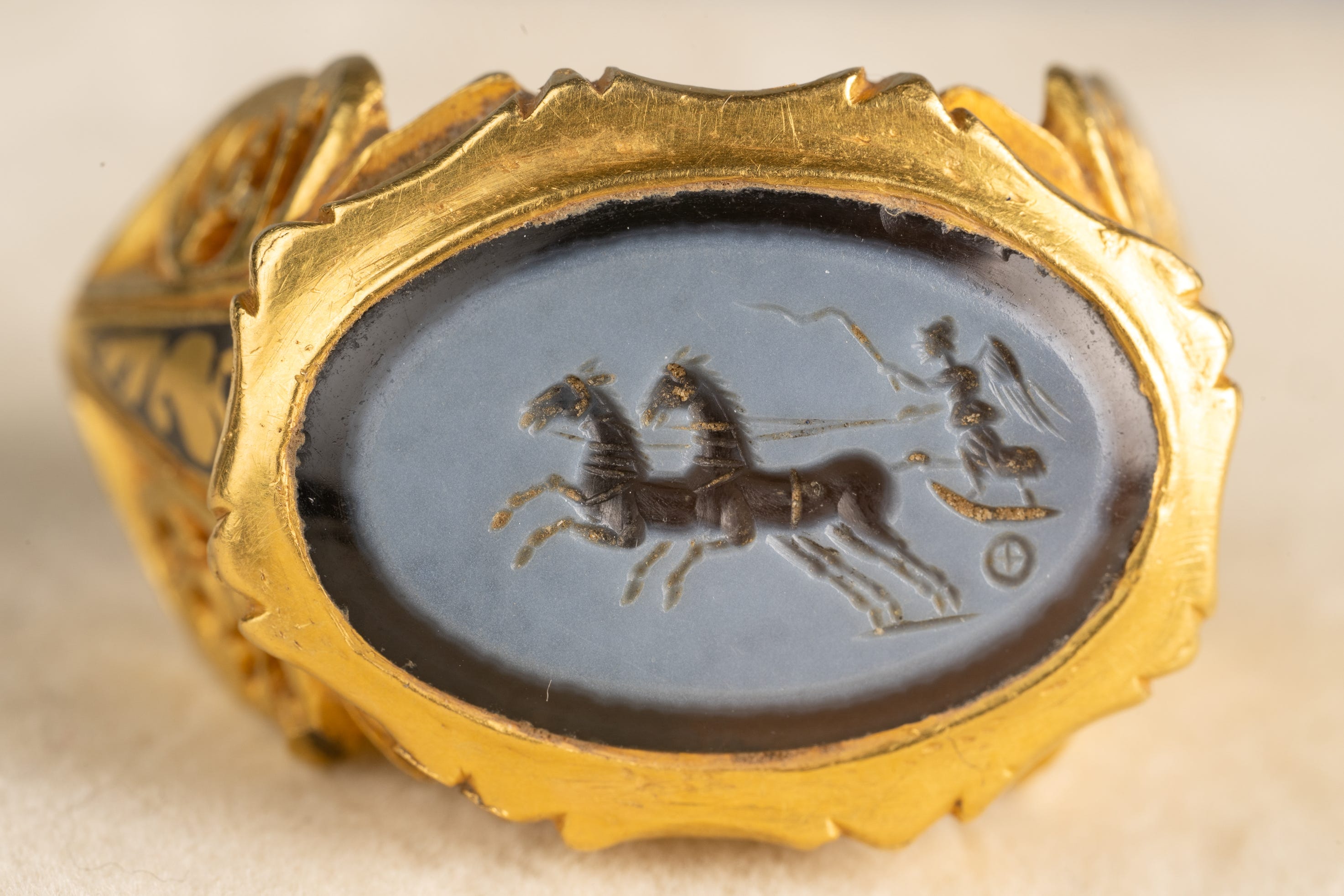
The ring itself was made sometime between 200AD and 297AD. Weighing an impressive 48 grams, it is unusually large and exquisitely crafted, set with a finely engraved gemstone depicting the goddess Victory driving a two-horse chariot. Rare both in scale and artistry, it is an unparalleled discovery for Britain and a unique find for South West England. The depiction of Victory is also a well-established and frequently recurring motif.
Of course, no-one can be certain of the exact circumstances surrounding the burial of the hoard, but it was common practice to conceal wealth during periods of instability.
So what was going on to make the end of the third century an unstable one in Roman England?
Unstable Britain
The Roman Empire was getting complicated with two emperors sharing the rule, Diocletian and Maximian. The latter was looking after the western half of the Empire and had promoted a man named Carausius to the rank of Admiral with ships to patrol the English Channel and North Sea.
Carausius came from the Menapii tribe (from the Scheldt estuary area of modern-day Holland and Belgium) and proved his ability to keep the Franks and Saxons at bay, at least until it became apparent that he was running a protection racket.
When he found out what was going on Maximian sentenced Carausius to death, so in 288AD the latter fled to Britain. Rather than work on an escape plan, he simply declared himself to be Emperor of Britain. Maximian was too tied up with fighting German tribes to do much about it but when he organised an invasion of Britain in 289AD, his fleet was either destroyed or dispersed by the weather.
Which, it is not exactly clear, but suffice it to say that the invasion failed to materialise.
Carausius controlled the British legions, the fleet and for a few years ran both Britain and North-West France, minting his own coins and maintaining Roman rule. Unable to do much about it while they were fighting the Germans, Maximian and Diocletian accepted the status quo. Britain had its very own Roman Emperor.
Eventually in 293 AD Maximian invaded France and drove Carausius out of his French possessions but he was unable to threaten his rule of Britain while Carausius controlled the seas.
However Carausius’s rule was ended in the same year, not by Diocletian or Maximian, but by his own minister, Allectus, who murdered him and took his place.
Unfortunately, Allectus did not show the same prowess as a leader and Emperor as Carausius and in 296 AD Maximian finally crossed the Channel and brought Britain back under his control.
This is the background, the story of Britian in the years leading up to the burial of the hoard at Ilminster. Burials of hoards were relatively common in uncertain times, It was seen as a way to keep your worldy goods safe and given that they stayed in the earth for some 17 centuries, the system clearly worked.
You might ask why was the hoard buried after Maximian’s reconquest when peace and the Western Emperor’s rule was restored. But of course we don’t know who the hoard belonged to. Perhaps it was a close associate of Allectus or Carausius who had reason to fear that his possessions might be confiscated?
Whatever the reason, the ring will now take centre stage in the South West Heritage Trust’s collection of Roman antiquities. Over the summer the Ilminster Ring will be involved in a programme of community engagement. In June, the Trust will visit local primary schools, giving children the chance to explore Roman history through this extraordinary object.
An Ilminster Ring Discovery Day will also take place at Ilminster Arts Centre on 20 August, featuring creative activities, talks and opportunities to learn more about life in Roman Somerset.
If you found this news release interesting, please share it with others so they can read it too:
Why not gift a subscription as a present for a friend or family member? You can do that here:
Somerset Confidential® is a reader-supported publication. To receive new posts and support our work, consider becoming a free or paid subscriber.
An extraordinary story. Up there with the Alfred Jewel. Perhaps even more precious and prestigious for being 400plus years older! I hope this one ends up in the Museum of Somerset.